
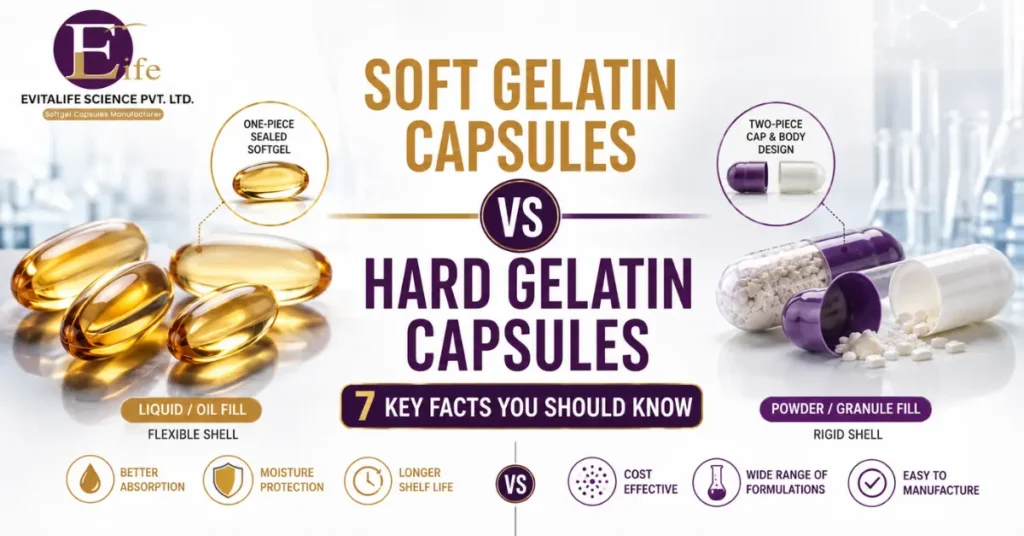
Soft Gelatin Capsules vs Hard Gelatin Capsules: The global Softgel market is around $8.5 billion in 2025 and is expected to grow around $15.4 billion by 2033. Choosing the right capsule is important for product formulation and business decisions.
Lets compare the Softgel capsule & Hardgel Capsule based on the 7 key factors.
What Are Soft Gelatin Capsules?
Softgel Capsules are capsules with soft and flexible outer covering. The covering is made of gelatin, water, and ingredients like glycerin or sorbitol. These ingredients keep the capsule soft and prevent it from cracking.
Composition and Structure
Softgel has a single sealed shell surrounding a liquid or semisolid fill. Unlike Hardgel, the capsule does not need a separate cap and body. The capsule is formed, filled and sealed in one process.
This makes softgel tamper resistant and difficult to open and refill without damaging them.
Common Uses in Pharma
Softgels are useful for oil based and fat soluble ingredients such as:
- Omega-3 fish oil
- Vitamin E
- Fat-soluble vitamins
- Herbal extracts
Gelatin based softgels are widely used in the pharma and supplements markets.
What Are Hard Gelatin Capsules? A Quick Overview
Hardgel capsules are the two piece capsules used for medicines and supplements . They have firm shells and are designed to hold dry powders, granules or pellets.
How Do They Work?
A hard capsule has 2 parts:
- Body: The longer part that holds the medicine.
- Cap: The shorter part that fits over the body and closes the capsules.
The ingredients are placed inside the body and the cap is fitted over it. This makes the capsule easy to fill and produce.
Common Uses
- Generic medicines
- Antibiotics
- Multivitamins
- Nutraceuticals and supplements
- Dry powders, granules, and pellets
These are popular because they are simple to manufacture and easy to fill. They are cost effective for large scale production.
Soft Gelatin Capsules vs Hard Gelatin Capsules: 7 Key Facts
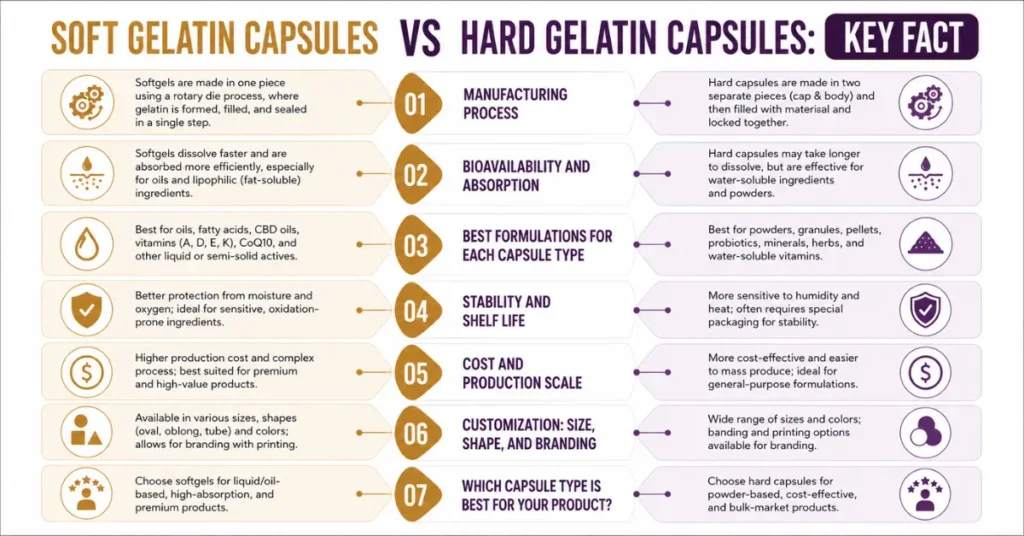
Key Fact #1 — Manufacturing Process
How Softgels Are Made
The softgels are made with a rotary die process. Two thin gel sheets are formed and the liquid ingredients are placed between them. The capsule is filled, shaped,cut and sealed at the same time.
This process needs specialized equipment, higher investment and careful process.
How Hard Capsules Are Filled
Hard capsules are made empty first. They are filled separately using machines that add powder, pallets or certain liquid into the capsule body. The cap is placed on top to close the capsule.
Filling and capsule production are different steps. Hard capsules are simpler and less expensive to produce at large scale.
Key Fact #2 — Bioavailability and Absorption
Softgels
Softgel contains active ingredients in liquid or oil form. Once the gelatin shell dissolved, the medicine inside is released. This helps the body to absorb fast and more easily.
This is especially used for drugs that do not dissolve well in water.
Hard Capsules
Hardgel usually contains powders, granules or pallets. The capsule first breaks, the content then dissolves in stomach fluid before the body can absorb the ingredient.
This step can sometimes make the process slower but this is not the problem for standard release medicine.
Key Fact #3 — Best Formulations for Each Capsule Type
Softgels: Best for Oils and Liquids
The softgels are ideal for oils, oil based ingredients and liquid formulations. Their sealed design helps hide unpleasant taste and smell. This is popular for products like fish oil or similar supplements.
Hard Capsules: Best for Powders and Granules
Hard Capsules are best suited for dry powders, granules and other solid ingredients. They are mainly suitable for general medicines, herbal powders and probiotic products. That is not stable in liquid formulations.
Key Fact #4 — Stability and Shelf Life
Softgels: More Sensitive to Moisture
Softgel capsules are affected by moisture. In dry conditions, they become hard and break easily. While, high humidity can make them soft and sticky.
Therefore, softgel needs proper packaging and careful storage.
Hard Capsules: Easier to Store
Hardgel Capsules are more stable under normal storage conditions. They are less sensitive to change in humidity.
This can make storage, shipping and distribution easier. When products are shipped across different climates.
Key Fact #5 — Cost and Production Scale
Softgels: Higher Production Costs
Softgel requires specialized rotary die machines, strict quality control, and higher initial investment. These make softgels more expensive to produce.
Hard Capsules: More Cost-Effective
Hardgel Capsules use widely available filling equipment and can contain simpler formulations. This makes them more affordable options for high volume production, especially for general medicines.
Key Fact #6 — Customization: Size, Shape, and Branding
Softgels: Flexible Shapes and Colors
Softgel can be made in different shapes such as ovals, spheres, and tubes. They can also be produced in different colors. However, detailed printing and branding on the shell can be more difficult.
Hard Capsules: Easier Branding
Hard capsules offer more branding options. They can use two different colors for cap and body and can have clear printing on both parts.
This is a good choice for companies that want products to be easily noticed on store shelves.
Key Fact #7 — Which Capsule Type Is Best for Your Product?
Softgels: Best for Nutraceuticals
Softgels are a good choice for fish oil, fat soluble vitamins and health supplements. Their appearance and liquid fill can give products a premium feel and may support faster absorption for some ingredients.
Hard Capsules: Best for Generic Products
Hard gelatin capsules are a practical choice for general medicines, antibiotics and powder based supplements. They are cost effective, easy to produce and widely used.
Soft Gelatin Capsules vs Hard Gelatin Capsules: Final Verdict
| Factor | Soft Gelatin Capsules | Hard Gelatin Capsules |
| Best for | Oils, liquids, suspensions | Powders, granules, pellets |
| Absorption | Generally faster | Slightly slower onset |
| Manufacturing cost | Higher | Lower |
| Shelf stability | Moisture-sensitive | More stable |
| Branding flexibility | Limited printing | Easy two-tone printing |
No one is better. The right choice depends on your formulation, target customers and budget.
How Evitalife Science Supports Both Soft Gelatin Capsules vs Hard Gelatin Capsules
At Evitalife Science we manufacture and supply both Softgels and Hardgels Capsules. This gives distributors and franchise partners the flexibility to build a diverse product portfolio. While working with a single supplier.
FAQs on Soft Gelatin Capsules vs Hard Gelatin Capsules
Q. Which capsule type is more popular in India?
Hardgel Capsules are more popular in India because they have lower production costs. They work well for generic medicines. However softgel demand is growing specially in the Nutritional Supplements market.
Q. Can hard capsules be converted into softgels?
Not directly. Hard Capsules and Softgel use different ingredients, formulations, manufacturing processes and equipment. Changing from Hard capsule to softgel requires reformulating the product.
Q. Are softgels more expensive to manufacture?
Yes, softgel production requires specialized rotary die equipment and tighter process control. This makes softgel more expensive to manufacture per unit than Hardgel.